

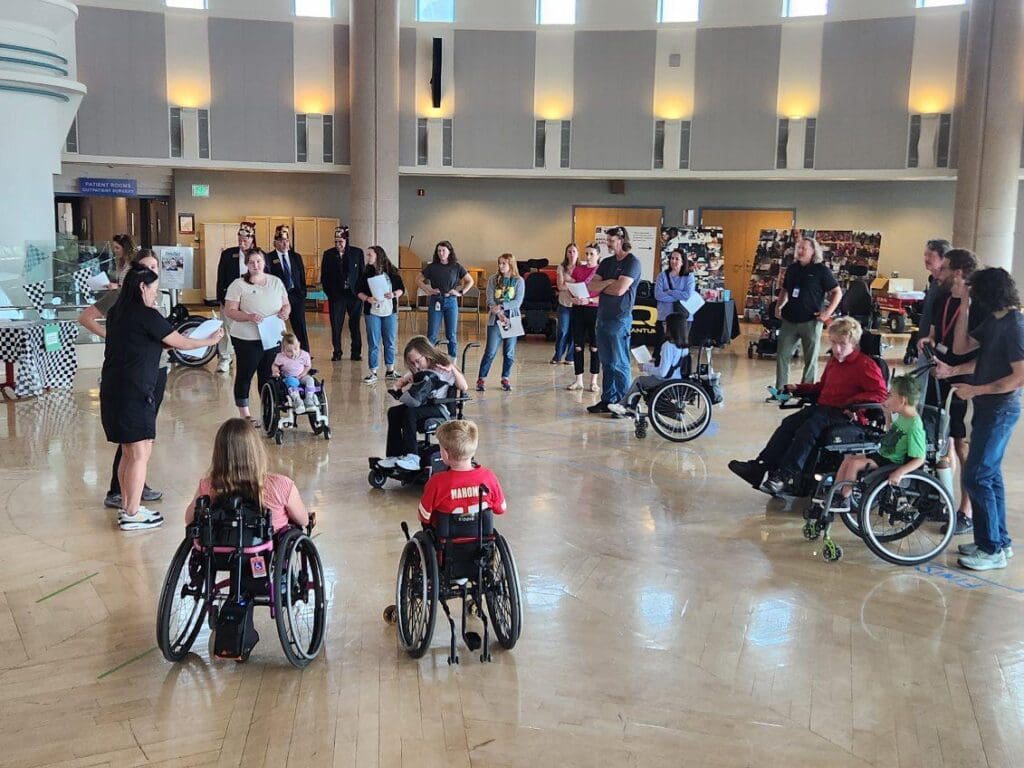
There are shrills of joy and laughter in the center dome, with sounds echoing throughout the hospital. Children ranging from 7 to 14 years old are rolling and driving around obstacles in the open area. Kids and parents are scattered throughout the spacious room, all with smiles and anticipation for the “road trip” they are about to embark on. That’s right folks, it’s Wheelchair Skills Day!
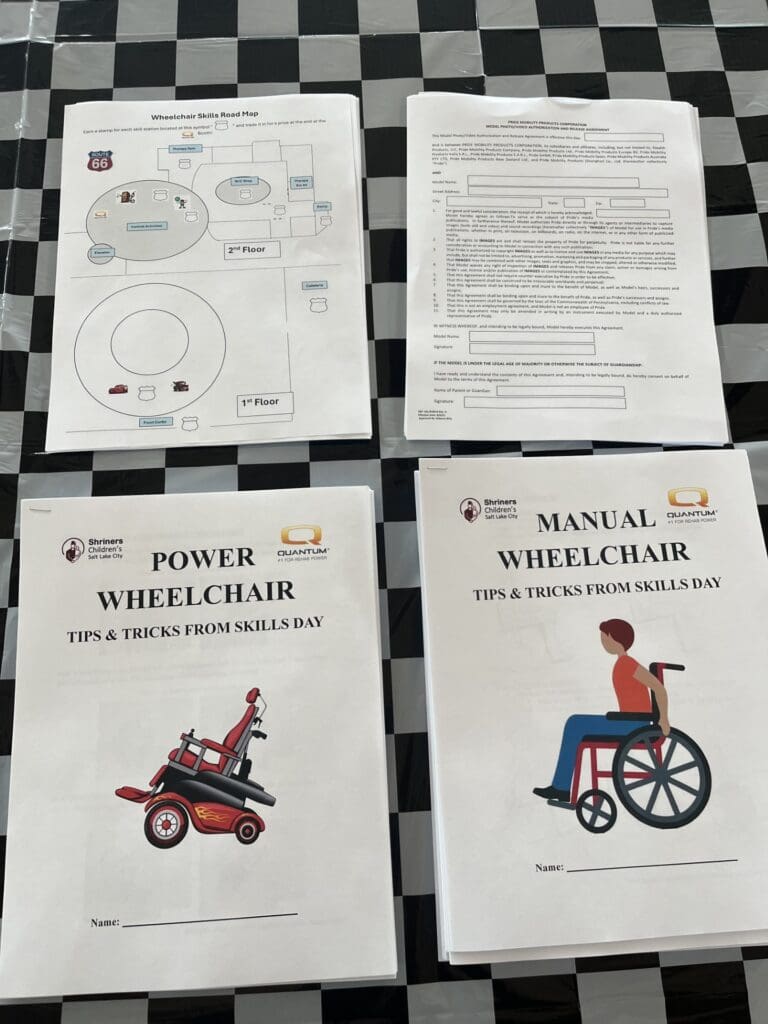
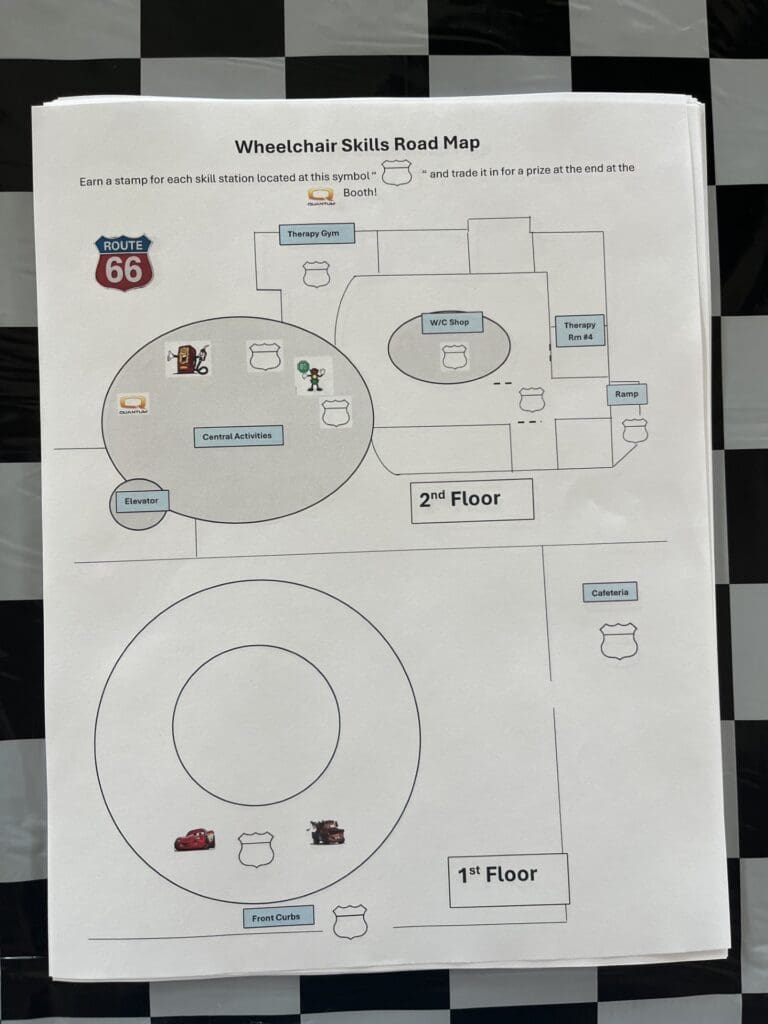
On September 19, 2025, a joint event was hosted by Quantum Power Rehab and Shriners Children’s Salt Lake City, called wheels workshop. Children in both manual and power chairs were invited to come and participate in the Route 66 themed wheelchair skills day. This was comprised of various stations located throughout the hospital that were managed by Shriners physical and occupational therapists. The children were able to get one-to-one training on a specific skill set at each of the stations. Once their “road map” of stations were all checked off, they earned a Quantum Swag bag as well as snacks to “refuel” after such a taxing journey. The stations that were selected focused on mobility, preservation and improving current techniques which are all listed below:
Warm up: This was a great opportunity for therapists to observe and assess overall ability to drive or push their chair. Trainers were able to intervene with tips or tricks on how to improve push strokes, approaching narrow spaces, assessing speeds or programming, ability to perform turns and overall control of their chair.
Doors: It is natural that as kids approach school age, they are also trying to gain more independence. A door-opening task is one that just needs more practice, may be emerging for our school age kiddos, or it is a task that can greatly benefit from some new alternative techniques. Participants were taught things like approaching the door, body positioning to access doorknobs and management of hemiparetic upper extremity.

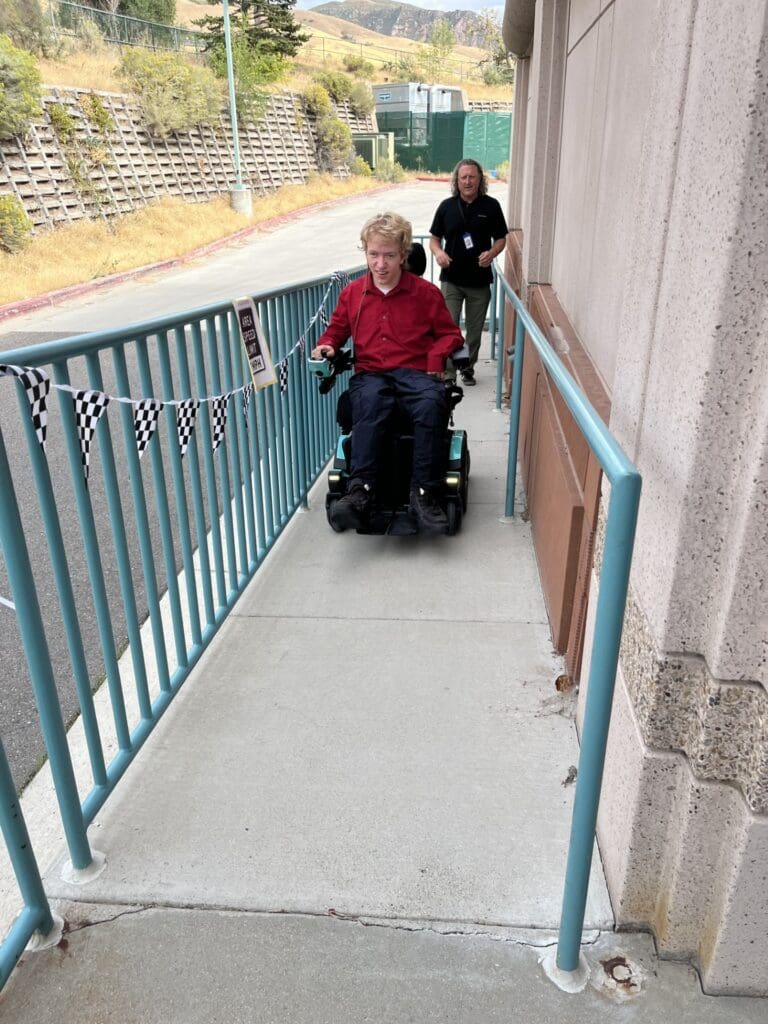
Ramps: These accesses are commonly used in the community, and simple tips can make a huge difference. It can help to improve safety, while also providing more confidence when they encounter one in a community situation. Participants were taught to utilize change of body positions whether this was from power seat functions or leaning trunk forward or back for our manual users.
Wheelchair care: Maintenance of the chair is an important factor in proper function and safety, while also assisting extending the lifetime of the chair. In this station, caregivers and participants were educated on basic care of their chairs like cleaning casters, battery care and greasing axles.
STOMPS: When we look at literature, we see that individuals in wheelchairs are at risk of shoulder pain because they are unable to rest their arms sufficiently because they are dependent on them for both locomotion and typical daily activities. We see that Strengthening and Optimal Movements for Painful Shoulders (STOMPS) exercise-based programs can be effective in reducing long-standing shoulder pain in wheelchair users as well as improved QOL scores (Mulroy et al. 2011). This was an important station to educate and train users early in attempts to either decrease risk of shoulder pain or provide the tools they need if they develop shoulder pain.

Transfers: With age, transfers can become more difficult and what once worked as a transfer method may not work as the child grows. There were various pieces of equipment set up (standard chairs, bath chairs, benches, etc.), where participants could practice transfer skills. This was a safe environment that allowed multiple opportunities to practice with assistance of a therapist to offer recommendations.
Curb and elevator management: For the manual chair users, this meant practicing popping those wheelies! This started from the basics of popping casters over a small rod, all the way to practicing popping wheelies for curb management. For the power wheelchair users, this meant making sure to align the front casters forward when encountering an obstacle. An elevator was required to return to the location of main event, allowing practice for body positioning, spatial awareness, timing and turning into small space.
“Red Light, Green Light”: To wrap up this fun event we combined a variety of skills with a game of “Red Light, Green Light.”
The background and purpose of this day was to allow a safe practice environment with skills that are used daily. As we know, children’s bodies grow and change with age. This can affect their strength, tone and overall movement strategies they use to perform their tasks. Without efficient independent mobility, young children are at risk of developing passive, dependent behavior and older children are at risk of decreased participation and isolation (Livingstone and Paleg 2013).
Good standard of practice offers training upon delivery of the chair. However, if a child receives their first chair at age of 2, the wheelchair skills that they need at age 7 are much different. Their world has expanded; they want to explore and be more independent. Where a kindergartener may have stayed in the classroom, now a grade-schooler is required to travel around the campus (library, cafeteria, etc.) or even switch classrooms upon junior high. Passive behaviors such as adults opening doors for them, pushing them into the elevator or over a curb has likely been a part of their early lives. This day was meant to review important skills or provide other techniques or tools that can assist with more independent wheelchair navigation.


Parent reports included: “Thank you so much,” “This was a lot of great information,” “We are excited to start opening doors more!” The children reported, “It was fun to meet other kids.” All in all, it was a successful day focused on community excellence toward improving children’s efficiency with wheelchair mobility. There were smiles, laughter and socialization. However, the key measure of success is the follow-up report of implementing the skills that they learned. One young man started to notice some shoulder pain and Mom reported, “We are going to start that program for his shoulders.”
This was an inaugural event but hoping to make it an annual day where young children can continue to improve strategies and independence with wheelchair skills.
Jennifer may be reached at jjanowicz@quantumrehab.com

Jennifer Janowicz PT, DPT, ATP is a seasoned physical therapist with 14 years of clinical experience, specializing in pediatric therapy. Her extensive background spans rehabilitation, acute care and outpatient services. Janowicz dedicated herself to supporting children and their families with complex seating and mobility needs at Shriners Children’s based out of Salt Lake City, Utah. Currently, she is an educator at Quantum Rehab, where she passionately shares her expertise in mobility and seating solutions.
References:
Mulroy, S. J., Thompson, L., Kemp, B., Hatchett, P. P., Newsam, C. J., Lupold, D. G., Haubert, L. L., Eberly, V., Ge, T.-T., Azen, S. P., Winstein, C. J., & Gordon, J. (2011). Strengthening and optimal movements for painful shoulders (STOMPS) in chronic spinal cord injury: A randomized control trial. Physical Therapy, 91(3), 305–329. https://doi.org/10.2522/ptj.20100161
Livingstone, R., & Paleg, G. (2014). Practice considerations for the introduction and use of power mobility for children. Developmental Medicine & Child Neurology, 56(3), 210–222.