

For more than 40 years, Ginny Paleg, PT, DScPT, MPT, has worked to expand what is possible for non-ambulatory children. She particularly focuses on those at GMFCS Levels IV and V, the most involved classifications of cerebral palsy, indicating significant limitations in mobility and reliance on other people and assistive technology for functioning, activity and participation.
Paleg earned her master’s degree at Emory University in Atlanta, Georgia, and her doctorate at the University of Maryland, Baltimore, and she has authored more than 60 peer-reviewed articles on standing programs, supported stepping, power mobility, hypotonia and hip health. She is the lead author of the American Academy for Cerebral Palsy Hypotonia Care Pathway and an active member of the American Academy for Cerebral Palsy and Developmental Medicine and the American Physical Therapy Association.
But in conversation, what emerges is a clinician shaped by families, driven by questions and anchored in one unwavering belief: access to exploration and participation is a human right.
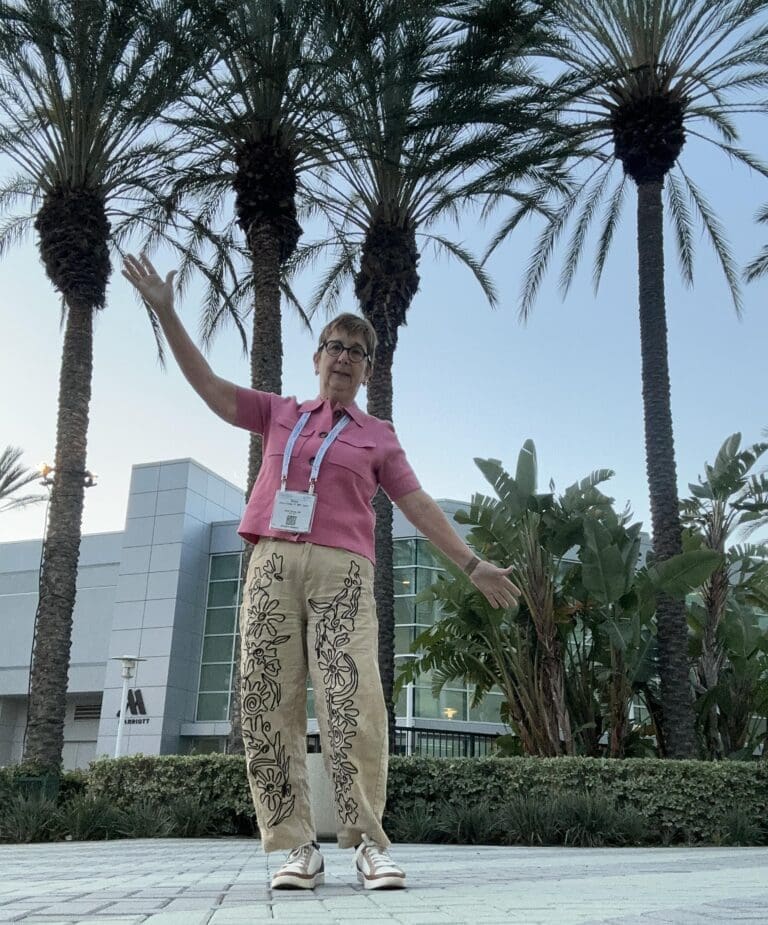 Ginny Paleg is a conference junkie! She has attended conferences in over 15 countries!
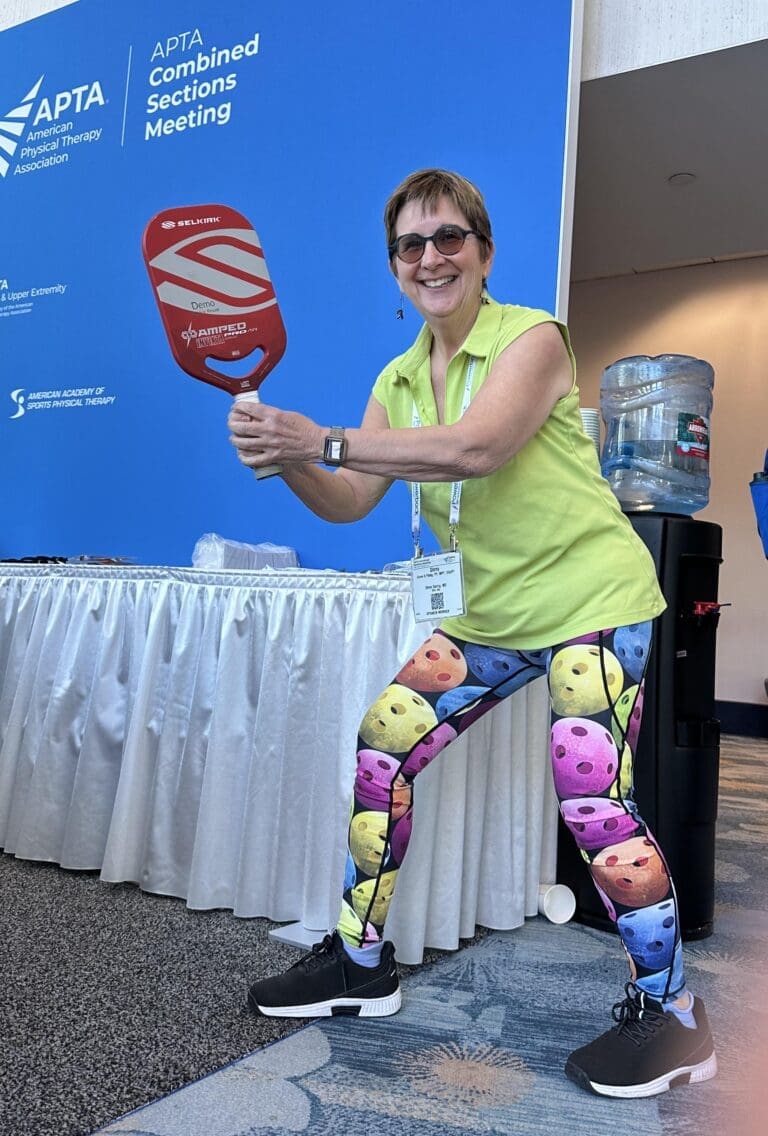 Ginny Paleg playing pickleball at the American Physical Therapy Association Combined Sections Meeting in Annaheim, California.
What first drew you to children who are often considered the most medically complex?
Part stubbornness, part curiosity and part very practical math. Early on, I was drawn to the children labeled “most medically complex” because the status quo for them was … almost nothing. Expectations were so low that I remember thinking, “I can’t possibly do worse than this.” Anything thoughtful, anything that centered the child as a child first was already an improvement.
These were children with enormous personalities and very clear preferences. And their families? Absolute masters of adaptation. They didn’t need someone to “fix” their child. They needed someone willing to try, to problem-solve, to admit what we didn’t know yet and to keep showing up.
I didn’t have language for frameworks then. I didn’t know about the F-words yet: functioning, family, fitness, fun, friendships, future. But families were already teaching me those values every day. They kept asking, “Is this worth our time? Is this helping our child live a bigger life?” That kind of partnership lit the research fire in me: the need to dig, verify, question and sometimes stand up and say, “This popular thing? It’s not helping the way people think it is.”
Those kids shaped how I define success. Not by how “normal” something looks, but by how much life a child gets to live now and into their future.
What have families taught you about resilience that no professional training ever could?
Families taught me that resilience is not heroic music and dramatic movie moments. It’s packing a feeding pump, extra clothes and a sense of humor into one backpack and still making it to the zoo. It’s celebrating a head turn, a glance, a shared laugh or a powered toy car lap like it’s an Olympic medal.
Professional training doesn’t fully capture the creativity of a parent who has redesigned daily life from the ground up and still makes joy non-negotiable. Families also have an incredible instinct for asking the questions that matter. Watching families chase possibilities while staying deeply practical is one of the most honest forms of evidence appraisal there is. Resilience looks less like “never giving up” and more like “fine, we’ll do it differently … and probably better … with snacks.”
And the biggest lesson? Resilience isn’t something professionals give families. It’s something families model for us, over and over, if we’re paying attention.
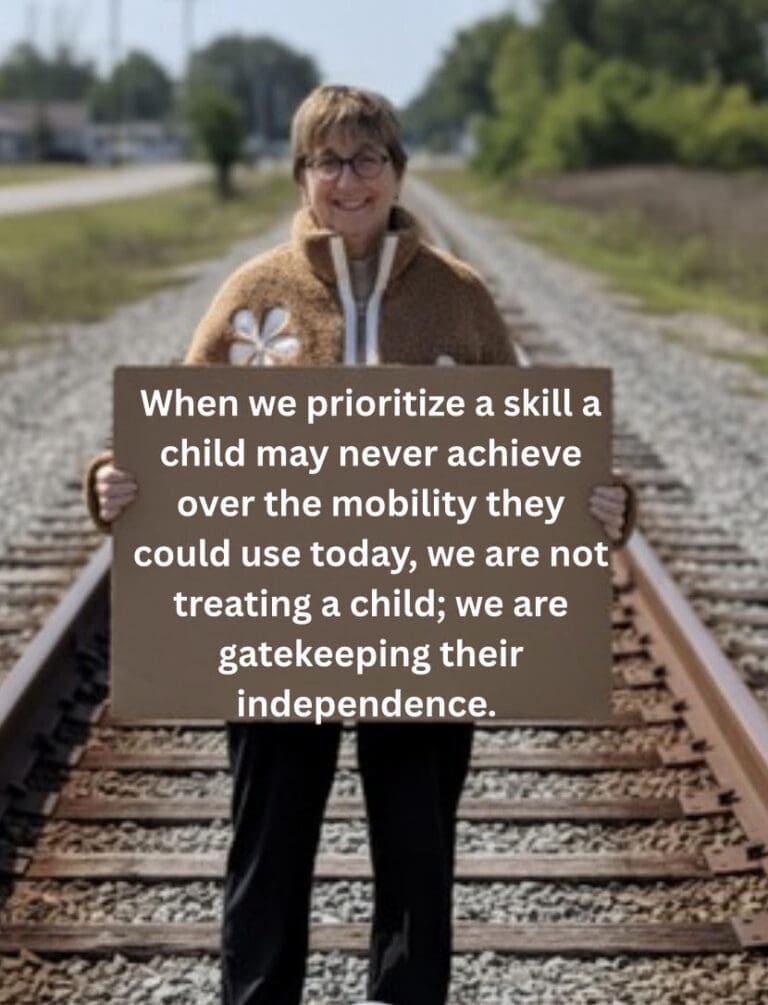 Ginny Paleg is very engaged in social media.
When you meet a child for the first time, what are you noticing that might never appear on an assessment form?
Of course, I’m thinking about safety, medical history and functioning. But I’m also watching things that will never show up in an outcome measure.
Is there fire in their eyes when something interests them? Do they scan the room looking for the next interesting thing? Do they laugh when someone is silly? Do they get that perfectly developmentally appropriate “naughty” sparkle that says, “I have opinions?” Those moments reveal drive, personality and social curiosity. They tell me what might motivate learning far more than a test item ever could.
I’m also paying attention to the family’s emotional weather. Hopeful? Guarded? Exhausted? Curious? Therapy doesn’t happen in isolation. It lives inside the life of a family.
I’m not just looking for what a child can do. I’m looking for who they are and what kind of life they’re trying to grow into.
How do you help families reframe mobility devices as tools for childhood rather than symbols of limitation?
This is one of my favorite conversations. A lot of my framing comes from Jean Minkle; the “power of ‘and.’” Not either/or. Not “if we use wheels, we give up on walking.” Childhood is big enough to hold multiple goals at once.
We’re working on exploration now because it triggers learning. When children can get to what interests them, we often see growth in cognition, communication, problem-solving, social connection and confidence. Movement is not just about muscles; it’s about access. And we will also work on walking, transfers and daily life skills that matter to a family. Mobility devices become tools for childhood when we anchor them in what children actually want to do: chase siblings, get to friends, participate at childcare, choose where to go instead of waiting to be carried.
Development is not a straight ladder where you must earn one skill before you’re allowed the next. Using wheels or power doesn’t “turn off” walking potential. If anything, it often turns on motivation and practice because the child is finally an active participant.
I often borrow an analogy: We don’t refuse eyeglasses and wait for eyes to get stronger. Assistive devices should be viewed the same way. Mobility devices aren’t symbols of limitation. They’re symbols of access to play, friendships, curiosity and being known for who you are.
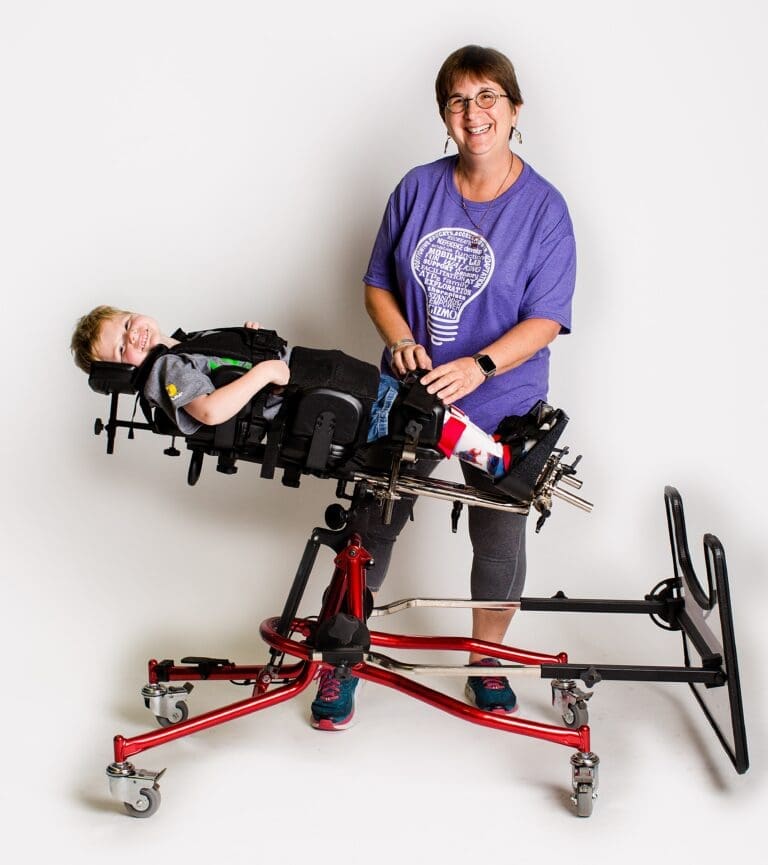 Ginny Paleg is an educational consultant for Prime Engineering, a fellow of CanChild and an honorary research fellow at University of KwaZulu-Natal, School of Health Sciences.
Have you noticed differences in how different cultures define independence for children with disabilities?
Absolutely. Culture shapes what independence even means. In some places, independence is defined as doing things without help. In others, interdependence — being part of family life, contributing meaningfully even with assistance — is the goal. Neither is inherently right nor wrong. They reflect deeper values about belonging.
The most pervasive “culture” I see cutting across everything is ableism. The quiet message that walking is the only mobility that counts. That effort is morally superior to access. That looking typical is more valuable than living fully. Families absorb that message from health care, education, media and sometimes even therapy.
What gives you hope when you think about the next generation of therapists?
They are motivated, values-driven and connected in ways we weren’t early in our careers. They’re asking harder questions sooner. They are less willing to accept, “This is just how it’s always been done.” They are engaging with lived-experience voices alongside research.
The therapists I meet are ready. Curious. Collaborative. They don’t seem as interested in being “the expert in the room.” They want to be part of teams with families, adults with disabilities and other disciplines. That shift alone changes the future of care.
But they need mentors. No one publishes, presents or meaningfully shifts practice alone. Every confident voice you see on a stage is standing on layers of mentorship. Mentorship isn’t just editing abstracts. It’s helping someone learn how to think critically, handle pushback, survive reviewer comments and stay grounded in families while pushing systems forward.
What questions still keep you thinking about this work?
The longer you do this, the sharper the questions get. Why does it take so long for good evidence to reach everyday practice? We can have strong, replicated findings and still see a decade pass before it becomes standard care. During that gap, children are living real lives.
How do we reach the average therapist? The one who has never attended a national conference, who is managing productivity pressures and documentation loads, who is trying to do right by families at 7:30 in the morning? If evidence only lives in journals and conferences, we haven’t changed practice. We have just changed conversations among people who were already listening.
I think a lot about translation. How do we make evidence practical and usable in real clinical contexts? How do we compete with something simple, confident and beautifully branded when evidence says, “It depends”?
Underneath all of that is one deeper question: How do we keep centering families and real life while systems and commercial interests try to pull the focus elsewhere? Those questions keep me reading, listening and (nicely, mostly) arguing.
Outside of work, what grounds you?
Being a grandma is at the top of the list. Loving a whole new generation without being the primary decision-maker is magic. It is pure delight and a constant reminder that childhood deserves space for joy, mess and personality.
I love pickleball for the game and the laughter. I love mahjong for the rhythm and connection. And one of my favorite rituals is sitting on the back porch with my husband, watching birds. It’s quiet. Grounding. A reminder to notice small things.
If I had to sum it up, outside of work I value connection, play and quiet moments, which, now that I think about it isn’t much different from what I value in my work.
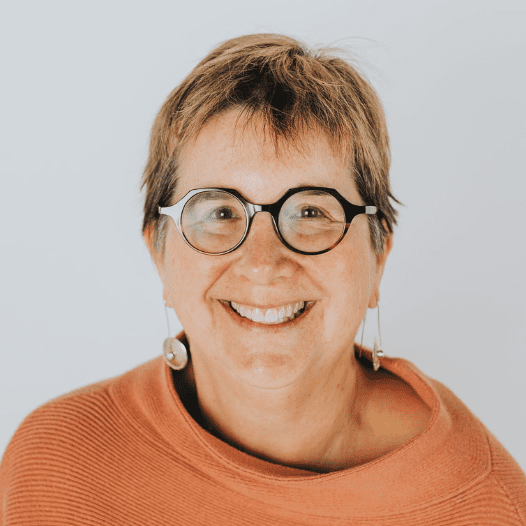
Ginny may be reached at ginny@paleg.com.
Ginny Paleg, PT, DScPT, MPT, is a physical therapist and researcher with more than 40 years of experience advancing care for children with significant motor impairments. She holds degrees from Emory University in Atlanta, Georgia, and the University of Maryland, Baltimore and has authored more than 60 peer-reviewed articles on standing programs, supported stepping, power mobility, hypotonia and hip health.