

I remember my early days as an occupational therapist in home health. One case stands out — a client desperately needed a wheelchair, and I was the only therapist available to help. It was one of the most demoralizing experiences of my career. I had no idea what my client truly needed, nor any clue about the equipment or seating that would meet their daily needs. Thankfully, that was the only home health case where I had to order a wheelchair.
Fast-forward 20 years. For the past decade, I’ve specialized in assistive technology at the Aaron W. Perlman Center at Cincinnati Children’s Hospital, working with wheelchair clients every day. I’m much more comfortable now, but the road to this point wasn’t simple — and I couldn’t have gotten here without a lot of help.
At the Perlman Center, we’re fortunate to have some of the best vendors and Assistive Technology Professionals in the world. Being surrounded by knowledgeable colleagues and seasoned Complex Rehab Technology Suppliers made my journey possible. More importantly, it allowed me to stay in my lane as an occupational therapist — using my clinical expertise to complement the technical knowledge these professionals bring to the table.
We’ve all heard the saying, “Fake it till you make it,” but that doesn’t work in the complex world of assistive technology.
Phil Wesley, ATP, with Numotion said, “It’s very important to pair new therapists in assistive technology (AT) with knowledgeable ATPs and vendors. That way, both professionals can focus on their specific roles while providing the best service for the family.” 1
At the Perlman Center, we see individuals with complex diagnoses — cerebral palsy, Duchenne muscular dystrophy and spinal muscular atrophy, to name a few. Each client brings unique challenges, but these cases often push even the most experienced therapists to their limits. They highlight the need for a team approach to achieve the best outcomes in positioning and equipment.
Ricky Alonzo, ATP, CRTS®, with National Seating & Mobility, said, “Strong collaboration between therapists and ATPs is essential for meaningful outcomes. When we communicate openly and problem-solve together, we turn clinical goals into practical equipment solutions that support function, safety and real participation in daily life. Open communication also builds confidence for clients and families and reduces future headaches.” 2
I recall one of my first AT cases — a child needed modifications to her wheelchair. I had completed the evaluation and determined her medical and positioning needs, but I had no idea how to order or fabricate the necessary components. I even doubted it was possible. Then the attending CRT Supplier walked me through the mold capture process and explained how custom molds can meet the most challenging needs. It was as though a whole new world opened up, and I felt grateful to be part of a team with such expertise.
John Stevens, ATP, Cincinnati Children’s Hospital Medical Center, said, “The vendor/therapist relationship is a team effort to produce positive outcomes. Therapists know the client’s physical strengths and limitations. Vendors know the equipment options to help overcome those limitations. Caregivers are also part of the team — their input ensures the equipment is transportable and home-accessible.” 3
CRT Suppliers bring critical experience to the table. As a therapist, my job is to address the medical aspects of each case with confidence in my OT training. While CRT Suppliers often understand medical considerations, their true expertise lies in matching equipment to the therapist’s assessment and the client’s needs. There’s overlap, of course, but when both professionals stay focused on their roles, the client benefits and quality of care is maintained.
Kelly Ball, PT, DPT, with Permobil, said, “Other clinicians may have more experience than I do, but I love collaborating with therapists, ATPs, and vendors because we all bring different perspectives. That diversity benefits the patient by providing well-rounded care from day one.”4
Being a team player took some getting used to — and still does at times. I like autonomy and control, especially with my clients. But in the complex world of assistive technology, one brain is rarely enough. Each week, I navigate numerous cases with vendor support — from positioning a bath chair in a home environment to installing gaze propulsion or optics for power wheelchair access. These cases underscore the importance of multiple viewpoints and creative solutions. Most CRT Suppliers would agree: a team approach beats working in isolation every time.
John Stevens, ATP, Cincinnati Children’s Hospital Medical Center, said, “Vendors and therapists are in the ‘helping’ business. If you don’t care about people with disabilities, you shouldn’t be in this field. Life is hard enough for the able-bodied —anything we can do to make life easier for clients and caregivers makes this work worthwhile and rewarding.”5
I’m thankful every day for the incredible vendors and ATPs who help balance my perspective and achieve the best outcomes for our clients.rements.
William may be reached at william.danner@cchmc.org.
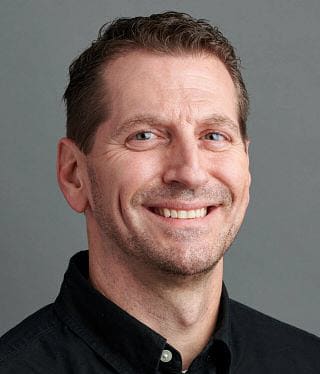
William Danner, MOT, ATP, CPST, has been an occupational therapist for over 20 years. He currently works at the Aaron W. Perlman Center at Cincinnati Children’s Hospital, which specializes in assistive technology.